The professional life is going on as usual. Reaching the office by 8.30, meeting people, responding to numerous emails, answering numerous phone calls, attending regular and adhoc committee meetings...the list is long. You come out at around 5.30 completely drained out only with enough energy to take the better half for a very short stroll. You are left with just enough time to check your facebook, run through twitter and few blogs blogs and watch TV news before retiring for the day. These daily chores keeps me away even from thinking and reflecting about other important aspects of life.The academic life has come to a halt let alone any creative work such as writing. The little cravings left for some basic research and writing is suppressed hard. Amidst this I often have started thinking if this is what I should continue doing the remaining part of active life or is there something else still waiting for me to do!! Should I follow my heart and relocate somewhere and lead a different and more exciting life? Is that life going to be different from this one?
Thursday, April 24, 2014
Sunday, October 6, 2013
Challenges in Motivating Students
(Presented in the First Conference of the Dean of Academic Affairs in August 2013, Sherubtse College, RUB)
Dr Shivaraj Bhattarai,
Dean, RTC
Abstract:
This paper is largely based on
personal observations and experience and also to some extent on few primary and
secondary data available at the college. The data are drawn from a large
numbers of feedback collected every semester from the faculty, staff and the
students of the college. The academic results, the student database as well as
some recent interviews of the students also form the basis of some of the
conclusions drawn.
Comparing to a decade past one
major change seen in the population of the students in higher education is the
mean age. Generally the mean age of college going students has come down to
about 19 years or lower now compared to above 21 in the nineties. This is
because students go to school at least by six, if not earlier, nowadays.
Further, with the emphasis for compulsory school education for all, the pass
percentage at schools has gone up very significantly and the survival rate is
as high as 85% (Statistical Year Book, MoE, 2012) pushing students much quicker
through the ladder of education. In addition, with the realization of the
importance of higher education among the Bhutanese populace, parents are
pushing their children through the higher education crowding limited
institutions to the brink.
On the other hand, youth are
growing amidst confusions created by unprecedented advancement in technology,
material growth and comforts that is brought home very easily. In general, the young students are subjected
to a great deal of distractions today that is taking away their attention from
the classrooms and impeding academic excellence. A large number of students at
RTC come from financially sound families which bring in complacency and
non-motivation for hard work. Many are ignorant of or are indifferent to the
emerging cut-throat competitions in the job market.
Exceptionally there are
in-service students who are much older and this small percentage in RTC (about
6% of the total) have a different story compared to the majority. Their
motivation in higher education is mostly driven by societal pressure and their
inner thirst for university degrees. For some it is the higher perks and
opportunities that come only with university degree. The above two categories
of students make an interesting and at times contrasting comparisons in
understanding the cause and challenges of motivations. Clearly it is important
for all the stakeholders, i.e., the parents/guardians, educationists (both
administrative and teaching), and the policy makers to understand the plight of
the youth today, and engage with them more closely and intimately to motivate
them and promote effective learning.
Thursday, September 26, 2013
Economics
of Education
Presented
at a conference titled The imperative of deepening democracy by BCMD in Thimphu on 1st and 2nd August.
The economics of education is about
understanding of how and why people make decisions to invest in education. It
also means the effect of education on long term social and economic outcomes.
It is also about the behaviour of those institutions involved in the production
of the education. The basic tools of economics provide the required framework
to evaluate education policies including early childhood interventions, pre-university
and university educational choice and financial aid.
The demand of education is based on
the model of human capital theory. So the education is seen as investment and
the acquisition of knowledge and skills as increasing the efficiency and output
which in turn increases earning; both at individual level and the national
level. On the other hand, the long term benefits that is more intrinsic such as
the appreciation of literature sometimes is referred to as “cultural capital”.
Perhaps in the GNH term, both human capital that is skilled and the cultural
capital which forms one of the important pillars of GNH are both relevant.
While the human capital can drive the technological progress and therefore
directly contribute to economic growth, the intrinsic value that education
provides helps to avert social evils and create an environment that is
conducive to growth and productivity. Statistics have shown that countries with
higher enrolment/graduation rates have grown faster than without. Example, USA
between 1910-1950 had the high school movement which resulted is boosting
economic growth in seventies and eighties. With the universal primary education
or education for all up to high school in Bhutan we could expect similar boost
in economy in next 10-20 years. At the same time, in addition to economic
growth, the value of learning history, literature and the social sciences will
add to curb social evils in the society and bring peace and harmony. Therefore
to me, the output of the production function of education is in both the terms
of the labour market success as well as the production of responsible citizens
who are positive and in appreciation of
cultural and natural heritage of the country.
Lastly, I would like to touch upon
the important paradigm shift in the investment on education at all levels.
Conventionally provision of schooling is largely provided and financed by
governments, especially the ones with socialist principles of governance.
However, with high demand for education and the diversion of government’s fund
in other sectors, the private sector investment on education is increasing at a
great speed. This is evident in the South Asian regions too and Bhutan is
slowly picking up. Some 25 years ago Bhutan saw its first private school which
emerged at the sheer necessity to meet the growing needs. Today we have several
private schools including a private college. We also understand that the more
private colleges are in the making and the education city that is developing is
also going to be a private enterprise.
One of the common concerns of the
private institutions is the quality of students supplied. If I give instance of
my own college, we are at par if not better in terms of physical infrastructure
and the faculty, with the government college. But because the government
colleges are fully funded, all the top performers are lost to the institution
leaving average or below average performers for RTC. This situation could be significantly
changed with the concept of public-private partnership (PPP). The immense pressure that the public
sector investment on education could be eased with PPP. It is hoped that this
partnership can lead to competition and expansion of equitable access and
quality education at large.
The above can be achieved by
financing the students or providing scholarships to the students rather than
the institutions and letting the students choose the best institutions,
entirely based on the programs and the quality. A responsible democratic
government will provide better choices to parents and students and open up greater
opportunities to them. Further, a democratic government need to properly
account for the quality and effective use of public resources. Of course the
government should also have its say on quality assurance. Therefore, the
success of PPP in education depends on quality assurance mechanism put in place
in consultation with the institutions, interventions such as teacher training,
school improvement initiatives (if required), bench marking etc.
With these initiatives, it
is hoped that the pool of educated people in the market will have equitable qualities
and abilities to compete and deliver effectively.
Saturday, May 19, 2012
It has not been easy writing. This job is keeping me very busy - more than my original profession of teaching. One activity leads to another, one program to next, one semester to next .. never seem to end. At times I wonder if I should go back to teaching and address my unquenched thirst for research and writing.
Four years down the line in this new position, I feel I should plan now to move further ahead into something else before I retire and start writing or join politics..or perhaps do both. I am not sure what would be that thing in the interim. Perhaps work somewhere - in US? may be or may be not..I need to firm up by the end of this year.
Monday, March 19, 2012
Why education?
Education has to be inclusive, wholesome and above all, it must help to develop skills that provide individuals with the needed competency to live their lives productively, meaningfully and fully. Furthermore, the tertiary education must bring about significant refinement and excellence in character, civic sense and sensitivity towards the other fellow beings. Such positive attributes must be reflected in his/her day to day conduct and interactions with his/her own family members, friends, seniors and the society at large. In the Bhutanese context, beyond the above expectations, the educated citizens must intelligently be able to appreciate and understand the importance of their national identity and culture and serve in their own best ways - the King, Country and its People.
Bhutan is aspiring for universal primary education by 2013 which is just a year away. It is with pride that some of the districts have declared this achievements already. There are pressures built on concerned officials to achieve the same in many other districts. Given the trend, we can expect similar declaration from all 20 districts by the deadline if not before.
However, it is important to understand what we are talking about! Is it that every kid at least gets enrolled irrespective of what happens to some of them after few weeks or months or years of enrollment? Are we also looking for measures to retain students to complete the schooling? If this is achieved, what about the quality? In the name of achieving universal education, are schools not under pressure to pass students through the schools? What about the aspirations of thse school drop outs and poor school graduates? Above all, do we have enough inter-sectoral discourses and the policies and support in place to address the sustainability of farming in view of these school graduates seeking jobs in the urban areas or simply refusing to dirty their hands in the field?
A lot of soul searching is necessary before it is too late!!
Bhutan is aspiring for universal primary education by 2013 which is just a year away. It is with pride that some of the districts have declared this achievements already. There are pressures built on concerned officials to achieve the same in many other districts. Given the trend, we can expect similar declaration from all 20 districts by the deadline if not before.
However, it is important to understand what we are talking about! Is it that every kid at least gets enrolled irrespective of what happens to some of them after few weeks or months or years of enrollment? Are we also looking for measures to retain students to complete the schooling? If this is achieved, what about the quality? In the name of achieving universal education, are schools not under pressure to pass students through the schools? What about the aspirations of thse school drop outs and poor school graduates? Above all, do we have enough inter-sectoral discourses and the policies and support in place to address the sustainability of farming in view of these school graduates seeking jobs in the urban areas or simply refusing to dirty their hands in the field?
A lot of soul searching is necessary before it is too late!!
Sunday, February 26, 2012
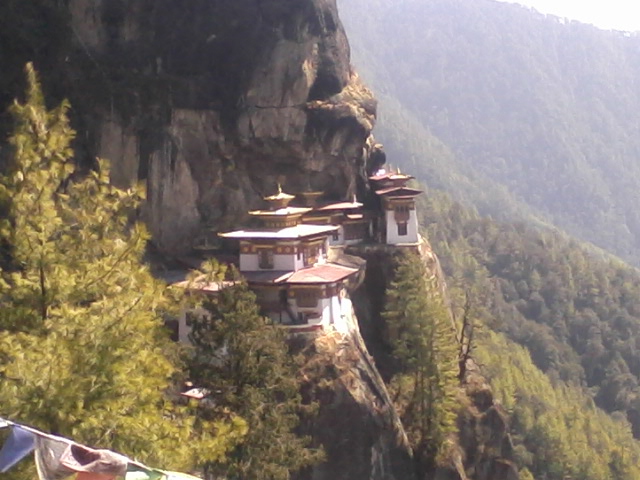
This Losar to Taktsang
The famous Tiger's Nest is a very popular destination for not just the Bhutanese but for almost every tourist who visits Bhutan. This holy place of worship is famous for its spectacular location on a breath-taking cliff that could momentarily shiver even the most daring skydiver. While it carries its history to the great Guru Padmasambhava, Milarepa, Pema Lingpa and many other legendary figures and saints of Tibetan and Bhutanese descents, the temple is said to have been constructed in 17th century by Tenzin Rabgay.
In spite of a major fire and destruction caused to many important parts of the monastery and its relics in 1998, the temple has been reconstructed to its original sacredness and even more grandeur infra structure.
On 22nd February, the Losar of the Year of the Dragon, I decided to make my fourth visit to this marvelous site, this time with my entire family and some relatives. The journey is shortened almost by 50% after the road has reached to the base of the mountain on the other side of the river. As we began our journey, some roadside vendors were just about to gather for their displays. There were already a dozen or more tourist vehicles parked with that many numbers of drivers lurking around, even though the tourism season is yet to pick up in Bhutan. While some tourists were loitering in the nearby wood, perhaps gauging if they should venture to that height or not, few had begun the journey. Several of them had one guide for themselves who were busy briefing on the importance of Taktsang, Bhutanese culture, the meaning of the inscriptions on the rocks, forest cover of Bhutan, environment, GNH, etc. It appeared that most of them were elderly people, perhaps rich enough to visit Bhutan as tourists (we call them high-end). We were all walking along, side by side, at times overtaking and other time getting overtaken..
After walking for more than an hour we reached the closet landing that provides a very beautiful sight of the temple. Some of our co-walkers decided to continue while many retreated towards the cafeteria nearby indicating that they would return from that point.
After a short rest, we continued towards the temple and found many people including Bhutanese pilgrims and the tourists had already reached up while some walked almost close with us. We sat opposite to the temple talking/debating about the history of its construction (very sketchy) - the chronology, the name of the builder, year of fire tragedy etc...
We finally went into the premise and tried entering each temple compartment and offered our prayers. As we returned, I saw most of these tourists asking lots of questions which I only hope our tourist guides are capable of answering. My faith on our tourist guides was shaken when a lady tourist (sounded like a Thai) requested to enter one other compartment that the guide had decided not to and he reacted in Dzongkha -tatara nga, mo nangna ra dam zhahungo! (I will just now lock her inside). This triggered a round of laughter from his guide friends who had gathered around the place. She understood that he was unhappy and sensing this on her face, the guide in turn immediately tried making his face look normal, and asked her to follow him into this chamber of lhakhang - but not before doing some damage to our culture.
We returned to the gate, picked up our stuff and gradually started returning. On the other side we stopped for some more pictures and eagerly awaited snacks and tea. As wee were discussing this nasty behavior of the guide, my eyes caught sight of the flattering plastic bags and papers (against the beautiful colorful flags) on the cliff below the temple. They were mostly concentrated below the residence of the monastery residents. There is no possible way to get rid of those alraedy on the cliff, but we can definitely put a stop on such careless disposal of the wastes.
It was almost past two in the afternoon when we decided to bid a good bye to this wonder piece of Bhutan (perhaps of the world) and quickly started descending. The tourists were returning too and many of them already were familiar faces and there were occasional warm wishes of Kuzuzangpo.
We had a late lunch at the bank of Pachhu before we retreated to unpredictable future!!
Till next time!
In spite of a major fire and destruction caused to many important parts of the monastery and its relics in 1998, the temple has been reconstructed to its original sacredness and even more grandeur infra structure.
On 22nd February, the Losar of the Year of the Dragon, I decided to make my fourth visit to this marvelous site, this time with my entire family and some relatives. The journey is shortened almost by 50% after the road has reached to the base of the mountain on the other side of the river. As we began our journey, some roadside vendors were just about to gather for their displays. There were already a dozen or more tourist vehicles parked with that many numbers of drivers lurking around, even though the tourism season is yet to pick up in Bhutan. While some tourists were loitering in the nearby wood, perhaps gauging if they should venture to that height or not, few had begun the journey. Several of them had one guide for themselves who were busy briefing on the importance of Taktsang, Bhutanese culture, the meaning of the inscriptions on the rocks, forest cover of Bhutan, environment, GNH, etc. It appeared that most of them were elderly people, perhaps rich enough to visit Bhutan as tourists (we call them high-end). We were all walking along, side by side, at times overtaking and other time getting overtaken..
After walking for more than an hour we reached the closet landing that provides a very beautiful sight of the temple. Some of our co-walkers decided to continue while many retreated towards the cafeteria nearby indicating that they would return from that point.
After a short rest, we continued towards the temple and found many people including Bhutanese pilgrims and the tourists had already reached up while some walked almost close with us. We sat opposite to the temple talking/debating about the history of its construction (very sketchy) - the chronology, the name of the builder, year of fire tragedy etc...
We finally went into the premise and tried entering each temple compartment and offered our prayers. As we returned, I saw most of these tourists asking lots of questions which I only hope our tourist guides are capable of answering. My faith on our tourist guides was shaken when a lady tourist (sounded like a Thai) requested to enter one other compartment that the guide had decided not to and he reacted in Dzongkha -tatara nga, mo nangna ra dam zhahungo! (I will just now lock her inside). This triggered a round of laughter from his guide friends who had gathered around the place. She understood that he was unhappy and sensing this on her face, the guide in turn immediately tried making his face look normal, and asked her to follow him into this chamber of lhakhang - but not before doing some damage to our culture.
We returned to the gate, picked up our stuff and gradually started returning. On the other side we stopped for some more pictures and eagerly awaited snacks and tea. As wee were discussing this nasty behavior of the guide, my eyes caught sight of the flattering plastic bags and papers (against the beautiful colorful flags) on the cliff below the temple. They were mostly concentrated below the residence of the monastery residents. There is no possible way to get rid of those alraedy on the cliff, but we can definitely put a stop on such careless disposal of the wastes.
It was almost past two in the afternoon when we decided to bid a good bye to this wonder piece of Bhutan (perhaps of the world) and quickly started descending. The tourists were returning too and many of them already were familiar faces and there were occasional warm wishes of Kuzuzangpo.
We had a late lunch at the bank of Pachhu before we retreated to unpredictable future!!
Till next time!
Friday, February 17, 2012
Cost of Democracy
As Bhutan embarked on democracy in 2008, the country's entire machinery including civil servants, police and armed forces were mobilised for several months in preparation for and execution of elections. There were electorate education drives reached out to every nook and corner of the country. This was followed by mock elections running into several weeks. All in all it was an unprecedented event for Bhutan and the Bhutanese. By the time two elections were completed in April of 2008, tens of millions of hard earned and hard borrowed money was spent. Many people even were quietly opposing such expensive elections. It was logical to think - perhaps this money could have been easily invested for much needed road and bridges that are crucial for the development and the welfare of the country. After all the governance, in whatever form, is all about the welfare of the citizens.
I have absolutely no intention to oppose democracy nor I would make fuss about a reasonable expenditure made for the process of election to ensure informed, free and fair election for a truly vibrant democracy. It is only under democratic conditions that every citizen can rightfully demand services from the elected government for better livelihood and aspire for higher goals. However the first election in Bhutan was definitely superfluous, unsustainable and beyond the means of the Bhutanese, however it was managed. In any case,even after so many expensive awareness campaigns, many voters in 2008 elections reportedly pressed unintended buttons!
We are just about one year away from second election. I would like to suggest to EC to do some soul searching (they could be already doing!), do cost-benefit analysis and set new standards for all concerned to control extravagant expenditures.
Some of the cost saving activities could be:
1. Let the Election Officers in the Dzongkhag be the election head and do not appoint another official except where there are more than two constituencies.
2.Completely do away with national observers. They are ceremonial figures and add no value to the process. Instead empower the local authority for monitoring the proper election process in each constituency with no additional allowance unless for travel, which will be very minimal.
3. Do not depute too many officials for the process at the voting centers particularly where the voters are few. In most centers one person can manage most activities, viz, checking the list, marking the fingers and also can monitor the buzzer. Two people are more than adequate in most of our voting centers.
4. Why security in non-border areas? If at all needed keep very minimum.
5. There is no big urgency to announce the results on the same day. Take your time and use the resources in the constituencies optimally.
Hope we can have a successful second election at a 50% less cost than the 1st one. After all there would not be elaborate electorate education nor a mock election prior to the second parliamentary election!!
I have absolutely no intention to oppose democracy nor I would make fuss about a reasonable expenditure made for the process of election to ensure informed, free and fair election for a truly vibrant democracy. It is only under democratic conditions that every citizen can rightfully demand services from the elected government for better livelihood and aspire for higher goals. However the first election in Bhutan was definitely superfluous, unsustainable and beyond the means of the Bhutanese, however it was managed. In any case,even after so many expensive awareness campaigns, many voters in 2008 elections reportedly pressed unintended buttons!
We are just about one year away from second election. I would like to suggest to EC to do some soul searching (they could be already doing!), do cost-benefit analysis and set new standards for all concerned to control extravagant expenditures.
Some of the cost saving activities could be:
1. Let the Election Officers in the Dzongkhag be the election head and do not appoint another official except where there are more than two constituencies.
2.Completely do away with national observers. They are ceremonial figures and add no value to the process. Instead empower the local authority for monitoring the proper election process in each constituency with no additional allowance unless for travel, which will be very minimal.
3. Do not depute too many officials for the process at the voting centers particularly where the voters are few. In most centers one person can manage most activities, viz, checking the list, marking the fingers and also can monitor the buzzer. Two people are more than adequate in most of our voting centers.
4. Why security in non-border areas? If at all needed keep very minimum.
5. There is no big urgency to announce the results on the same day. Take your time and use the resources in the constituencies optimally.
Hope we can have a successful second election at a 50% less cost than the 1st one. After all there would not be elaborate electorate education nor a mock election prior to the second parliamentary election!!
Subscribe to:
Posts (Atom)