Sunday, February 26, 2012

This Losar to Taktsang

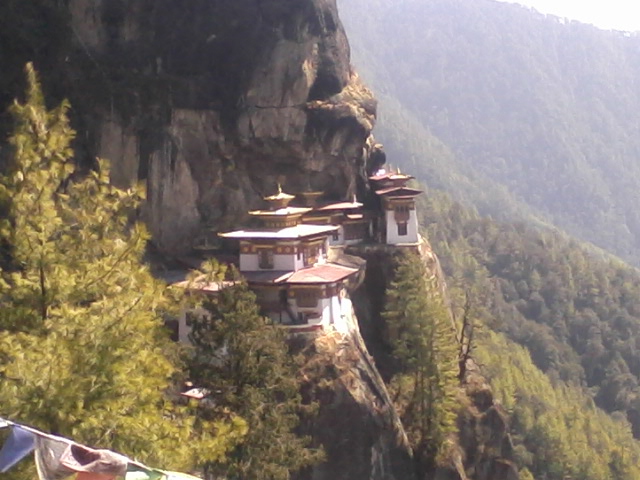
The famous Tiger's Nest is a very popular destination for not just the Bhutanese but for almost every tourist who visits Bhutan. This holy place of worship is famous for its spectacular location on a breath-taking cliff that could momentarily shiver even the most daring skydiver. While it carries its history to the great Guru Padmasambhava, Milarepa, Pema Lingpa and many other legendary figures and saints of Tibetan and Bhutanese descents, the temple is said to have been constructed in 17th century by Tenzin Rabgay.
In spite of a major fire and destruction caused to many important parts of the monastery and its relics in 1998, the temple has been reconstructed to its original sacredness and even more grandeur infra structure.
On 22nd February, the Losar of the Year of the Dragon, I decided to make my fourth visit to this marvelous site, this time with my entire family and some relatives. The journey is shortened almost by 50% after the road has reached to the base of the mountain on the other side of the river. As we began our journey, some roadside vendors were just about to gather for their displays. There were already a dozen or more tourist vehicles parked with that many numbers of drivers lurking around, even though the tourism season is yet to pick up in Bhutan. While some tourists were loitering in the nearby wood,  perhaps gauging if they should venture to that height or not, few had begun the journey. Several of them had one guide for themselves who were busy briefing on the importance of Taktsang, Bhutanese culture, the meaning of the inscriptions on the rocks, forest cover of Bhutan, environment, GNH, etc. It appeared that most of them were elderly people, perhaps rich enough to visit Bhutan as tourists (we call them high-end). We were all walking along, side by side, at times overtaking and other time getting overtaken..


After walking for more than an hour we reached the closet landing that provides a very beautiful sight of the temple. Some of our co-walkers decided to continue while many retreated towards the cafeteria nearby indicating that they would return from that point.
After a short rest, we continued  towards the temple and found many people including Bhutanese pilgrims and the tourists had already reached up while some walked almost close with us. We sat opposite to the temple talking/debating about the history of its construction (very sketchy) - the chronology, the name of the builder, year of fire tragedy etc...

We finally went into the premise and tried entering each temple compartment and offered our prayers. As we returned, I saw most of these tourists asking lots of questions which I only hope our tourist guides are capable of answering. My faith on our tourist guides was shaken when a lady tourist (sounded like a Thai) requested to enter one other compartment that the guide had decided not to and he reacted in Dzongkha -tatara nga, mo nangna ra dam zhahungo! (I will just now lock her inside). This triggered a round of laughter from his guide friends who had gathered around the place. She understood that he was unhappy and sensing this on her face, the guide in turn immediately tried making his face look normal, and asked her to follow him into this chamber of lhakhang - but not before doing some damage to our culture. 


We returned to the gate, picked up our stuff and gradually started returning. On the other side we stopped for some more pictures and eagerly awaited snacks and tea. As wee were discussing this nasty behavior of the guide, my eyes caught sight of the flattering plastic bags and papers (against the beautiful colorful flags)  on the cliff below the temple. They were mostly concentrated below the residence of the monastery  residents. There is no possible way to get rid of those alraedy on the cliff, but we can definitely put a stop on such careless disposal of the wastes.

It was almost past two in the afternoon when we decided to bid a good bye to this wonder piece of Bhutan (perhaps of the world) and quickly started descending. The tourists were returning too and many of them already were familiar faces and there were occasional warm wishes of Kuzuzangpo.


We had a late lunch at the bank of Pachhu before we retreated to unpredictable future!!

Till next time!


Friday, February 17, 2012

Cost of Democracy

As Bhutan embarked on democracy in 2008, the country's entire machinery including civil servants, police and armed forces were mobilised for several months in preparation for and execution of elections. There were electorate education drives reached out to every nook and corner of the country. This was followed by mock elections running into several weeks.  All in all it was an unprecedented event for Bhutan and the Bhutanese. By the time two elections were completed in April of 2008, tens of millions of hard earned and hard borrowed money was spent. Many people even were quietly opposing such expensive elections. It was logical to think - perhaps this money could have been easily  invested for much needed  road and bridges that are crucial for the development and the welfare of the country. After all the governance, in whatever form,  is all about the welfare of the citizens.

I have absolutely no intention to oppose democracy nor I would make fuss about a reasonable expenditure made for the process of election to ensure informed, free and fair election for  a truly vibrant democracy. It is only under democratic conditions that every citizen can rightfully demand services from the elected government for better livelihood and aspire for higher goals. However the first election in Bhutan was definitely superfluous, unsustainable and beyond the means of the Bhutanese, however it was managed.  In any case,even  after so many expensive awareness campaigns, many voters in 2008 elections reportedly pressed unintended buttons!

We are just about one year away from second election. I would like to suggest to EC to do some soul searching (they could be already doing!), do cost-benefit analysis and set new standards for all concerned to control extravagant expenditures.
Some of the cost saving activities could be:
1. Let the Election Officers in the Dzongkhag be the election head and do not appoint another official except where there are more than two constituencies.
2.Completely do away with national observers. They are ceremonial figures and add no value to the process. Instead empower the local authority for monitoring the proper election process in each constituency with no additional allowance unless for travel, which will be very minimal.
3. Do not depute too many officials for the process at the voting centers particularly where the voters are few. In most centers one person can manage most activities, viz, checking the list, marking the fingers and also can monitor the buzzer. Two people are more than adequate in most of our voting centers.
4. Why security in non-border areas? If at all needed keep very minimum.
5. There is no big urgency to announce the results on the same day. Take your time and use the resources in the constituencies optimally.

Hope we can have a successful second election at a 50% less cost than the 1st one. After all there would not be elaborate electorate education nor a mock election prior to the second parliamentary election!!  

Thursday, December 22, 2011

The Golden Ring - Tulasa

The best of its kind,
presented by beautiful minds;
the precious gift will be valued till the end.


A few years of working together, brought closer in hearts,
Lessons prepared, discussed and infused into the innocent minds;
But the sands of time changed my trail,
And I ought to forget my teaching lines.


Dear students, Principal, colleagues and friends,
The value you perceived would not strike the great minds.
The heart beat stops when the word flows,
"the words are less when the heart is full", someone said of course!


I am thankful in my thoughts and prayers,
For your empathy, the love and care.
Humanity, togetherness and the value shared,
The golden ring you gifted will glitter forever.

Friday, December 16, 2011

Year 2011

It is amazing and at times sad to see how fast the time flies! As 2011 goes by, I try recollecting all the past 10 or 20 years that I spent. It is really hard. I cannot even recollect anything happening in some of the past years, as if those years did not exist at all! How could that be 365 days just did not make any significant impact on my memory!!
Anyways, 2011 is also almost gone. This is beginning of my 4th year in this new college. After 17 years at Sherubtse and few more years in service before that, I completed 23 years of job in the government as of 2011. I decided to cut my official knot with the university. I am processing my retirement benefits and is able to see so little money from my 17 years of service. Perhaps enough to buy  a small housing plot  somewhere in a small town. Big ones are beyond my budgetary scope. Dream of building a small home is still far fetched.
The early pension that will start coming after 3 years will perhaps buy me monthly ration!

In the meantime, I like to look forward to some more exciting work and output bearing greater satisfaction at RTC and hope to see some more parts of the world and life before I may be able to retire and catch up with my big family circle...

Friday, December 2, 2011

A letter with philosophy and wisdom from a recent visitor to my office

With all my respect to Prof Islam, I reproduce as he wrote:


03 12 11

Dr Shivaraj Bhattarai
Dean
Royal Thimphu College
Bhutan

Dear sir

My very recent visit to your campus in a quiet late afternoon has been my introduction to a realm of possibility. I felt its fundamental relevance to me : a mind in search of knowledge, equilibrium and perpetuity.

The elements of pure learning that gradually herald enlightenment into young minds, I found, are present there. These are tranquility, basis in nature, simplicity and pure youth. Your ambience testifies to a potential : unique, lithe and sovereign.

That you have assorted the classical thoughts and practices from across the globe in the course curricula is a positive enterprise. The Bhutanese learners do possess an essential identity for being able to assimilate this academic exposure into a strengthening nourishment. I foresee their noble evolution. However existence cannot be but a progression to be overviewed by time.

I value my interaction with you. You offered a listening ear to me. We share the solidarity of witnessing and understanding that education elevates from weakness to strength, from groping to controlling, and from dominance of instincts to calm inspiration.

In a campus of true making, all learn - who teach and who are taught.

Yours sincerely
Ahmed Iftekharul Islam
University of Science and Technology Chittagong
Bangladesh

Thursday, October 20, 2011

Back in Thimphu after 20 years! (published by Bhutan Times in 2008)

I am absolutely filled with emotions- no better way of getting out of it than jotting some of that down. I have never written anything seriously in my life except my thesis some five years ago. A strange feeling of detachment from my 17 years of passionate teaching at Sherubtse has inspired me to write today.

As a fresh university graduate in 1987, Thimphu looked and smelt different to me. Coming from Sherubtse then, Thimphu still looked crowded, cramped and full of vehicles. As a very normal practice those days, I had gone through the chores of civil service exams, officers’ training and attachment programmes. Scholarship came by without much effort but with a string attached – earmarked to teach at Sherubtse. When I landed back at Sherubtse in 1991 to be on the other side of the table this time, I had not even a faintest of idea that I would spend 17 best years of my life there. Time rolled by with every passing batch of graduates and arrival of the fresh ones. Almost at the same proportion was faculty turn over. Only when you occasionally meet your older students driving the newest of cars in the country, turned plump and flanked by their grown up children, you get an explanation to your receding and graying hair and you are alerted about your own future.

Something suddenly struck my mind and I did decide to leave Sherubtse surprising many there – even myself. I had seen this college grow from pre-University to degree, from some 200 to 1000 students and mere 20 to over 100 faculty members. More recently, new buildings, new facilities, new courses and modern amenities trickling down brought comforts and excitements and also the growing problems challenged the management in many ways.

I had landed at Sherubtse from Thimphu in a government Hilux with just a cooking gas cylinder and a bedding rolled in a typical green coloured thick cloth case and this week when I returned to Thimphu I had my own (the only tangible saving )– a brand new Getz car that I proudly bought without taking any loan. Of course a truckload of old furniture, utensils and clothing, and books also followed me, not to mention a newly bought pair of reading glass that I vehemently refuse to put on. As I put up with my son, who is recently employed, in a cramped house overlooking a dusty and busy highway, I am constantly reminded of my beautiful government bungalow within very green Sherubtse campus, which I had occupied only about 15 months ago after changing some six other different quarters.

I walked into my new office only to find some contractors and engineers discussing the construction project. No academics yet! I missed my teaching, the crowd of young men and women in the corridors, on the play fields, mess and hostels. I missed my colleagues, occasional exchanges of greetings, discussions and gossips of all kinds (salary raise being the most prominent) and above all the serene environment of Kanglung. But then why did I choose to abandon all that I cherished?

As I sit back in the new office at Thimphu all by myself, I try to reason out. Only thing that comes to my mind is Thimphu vs Kanglung phenomenon. Over 600 kms of rugged road commanding two full days of tiring drive from our lateral route and even the greater distance through volatile Assam state of India, Eastern Bhutan even today is truly Jamie Zeppa’s “Beyond Clouds”. Quite often frustrated with all these difficulties, I had questioned to myself - who has stayed at Sherubtse more than me? Obviously, no one and why should I? I have seen many officials have started their career in Thimphu and retired from here. They always grumble about high living standard in the capital city, difficult to pull on etc. but never agreed to get away from Thimphu. Some of them also have managed to buy ‘plots’ and build houses and send their children abroad. There must be some Thimphu tricks that I may as well try out and experience the glamour, I suspect also there is.

I ran into some of my old friends during the last few days in-person and through means of communications. They congratulated me for ‘getting out’ of there and wished me better luck. But for now I am yet to come out of Sherubtse reminiscence and more importantly I have to soon come to terms with my new job.

Seven Life Imprints ( published by Business Bhutan in their popular column ‘Seven’ – Vol 1,  Isuue 32, May 01, 2010)
1.     My first world
My early childhood memory in Dorokha is limited to a primary school of barefoot students with two teachers doing multi-grade teaching. The summers were marked with melodious rice plantation-rhymes sung by brightly dressed women folk; autumn with deusis ‘played’ with young village boys during Tiwar (a Hindu festival of light); winter with sound of horses’ bells of visiting Haaps; few exciting days of marriages of teenage couples glorified with deafening blank gunfire by the most ‘dashing’ man of the village, the juicy golden oranges, people returning home from market - smelling of kerosene, spilled over their backs from the porous bamboo baskets. At all seasons, there stood an unfaltering temple next to the house where occasional gatherings occurred for religious discourses. There was a shaman, regarded as next to God, who treated all the diseases and kept so many super natural beings in good humour. Completing the cycle were the corpses, being whisked towards the river Amochu, for cremation. This was the entire world I thought!
2.     A new world discovered
At the age of 12 in 1974, my father along with few hundred villagers escorted me  across Amochhu, Sanguri and after two days of bare feet walk, to a completely new world of paved roads, electricity, and automobiles.That evening I got the first haircut by a barber, got first pair of slippers (chappals), and a trouser – only to be complimented by a new piece of terry- cotton shirt that was to come next day as a Soelra, from none other than the fourth Druk Gyelpo. Yes! the crowd from all over the places gathered on the ground, the first ever big crowd I saw in life, to hear the remarkable voice of young monarch through a miraculous voice amplifier (mike) and to get a glimpse of the most handsome leader of the world.
3.     Gold Medal
This was the second convocation at the peak of learning- Sherubtse. I was honored with the Jigme Wangchuck Gold Medal for Excellence in character and studies. During the recess that day in April 2008, my mentor, Father Leclaire put his arm across my shoulder and said that it was the decision of the entire faculty and I should live up to their expectations. I was overwhelmed and equally felt the weight of the responsibility I was to shoulder now.
4.     In Japan
On one of the few foreign visits, I, one day in March 2003, landed in Osaka. Overwhelmed by the opportunity, I spent almost 10 sleepless nights trying to get best out of the experience of travelling by remarkably punctual trains, the unbelievably clean streets, extremely disciplined and hard working people and of course scores of events of the Third World Water Forum.
5.     Yet another Convocation
My wife Tulsa, our two sons, Arun and Suraj joined me in my PhD convocation in a small hilly station of Shillong in North east India. On that lovely autumn night we rejoiced the joint achievement over a family dinner in a great old palace standing over the Shillong peak.
6.     A Teacher’s Day at Sherubtse 
This was my 16th year being on the faculty at Sherubtse. Accidentally the leadership of the college had fallen on me for a very brief period. The entire student body came together to honour all the hundred odd faculty members and showered us with praises. 
7.     Touched by my King
I was one of the thousands Bhutanese witnessing the Coronation ceremony of the Druk Gyelpo Jigme Khesar Namgyel Wangchuck at Changlimithang in December 2008. The young monarch walked slowly across, talking, smiling and touching the people and made a momentary stop in front of me. He put his gracious hands on my shoulder preventing me from getting up and kindly asked, ‘where are you now?’ I was chocked with joy and only could say, ‘I am the Dean at the Royal Thimphu College”.  His Majesty then caressed my balding head basked in the sun and kindly remarked, “Have you applied the sunscreen? It may hurt you later. Thank you for coming (to the function)”. 
I could ask for no more.